By Tyler Hoar:
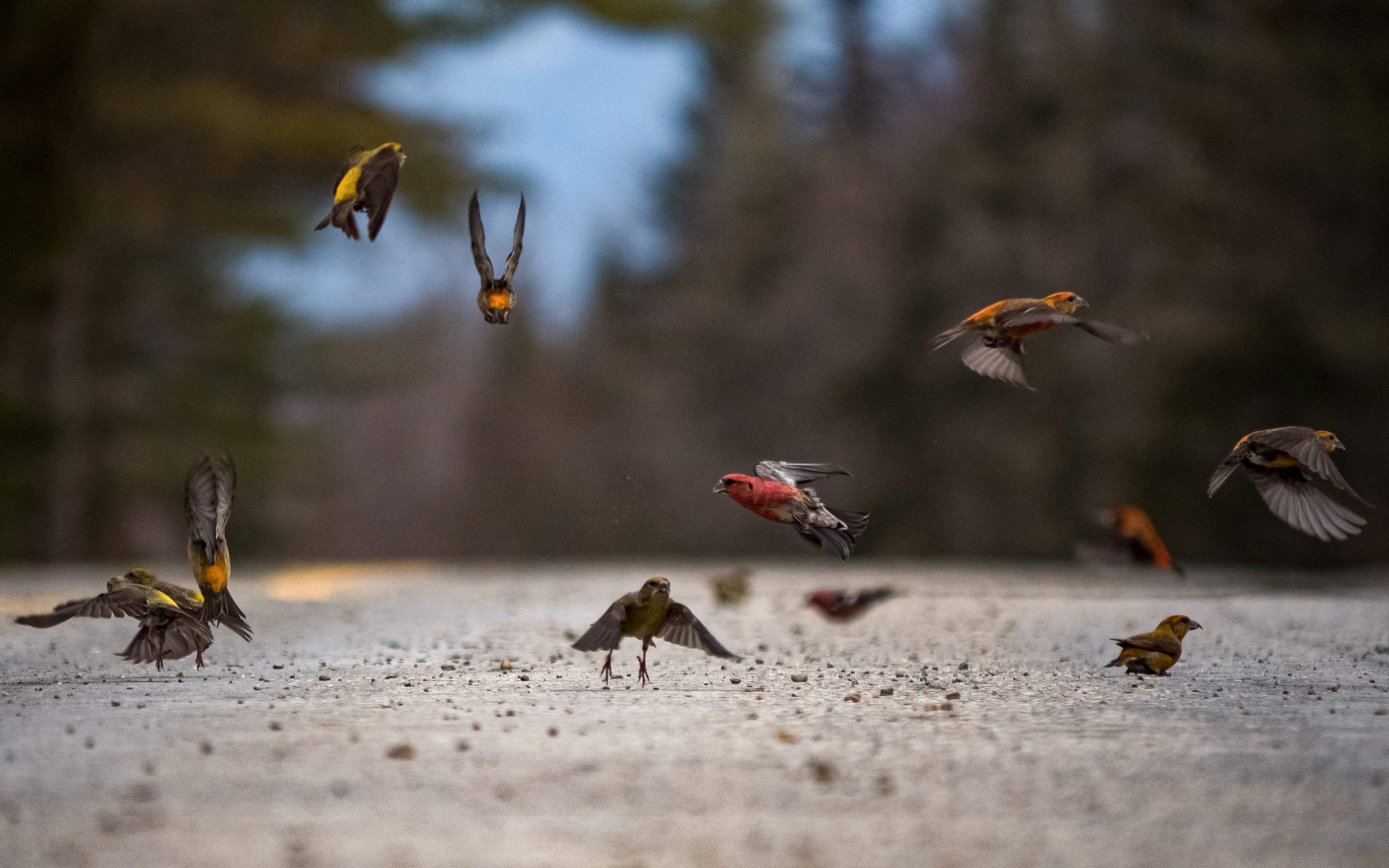
Cover Photo of Dancing Crossbills by Jamie Sylvan–
GENERAL FORECAST:
Last year was a bit of a mixed bag for boreal irruptions, but it was a solid flight year here in the East for Evening Grosbeaks, Pine Grosbeaks and Purple Finches with a small flight of Pine Siskins too. The picture looks mixed again this year, as crops are good in the east and the far western parts of the boreal, but are largely poor in the central areas of the boreal. The overall poor seed crops in a vast area of the central boreal will likely cause finches to move into Eastern Canada, the Great Lakes region and northeastern United States, but birds will likely be in the woods more than at feeders due to plentiful seed resources in the northeastern conifer forests. We do not expect any big irruptions of any of the finches in the southeastern states this year.
There are two areas of good food crops, 1) in the east from central Ontario eastward into the Maritimes and the northeastern United States, and 2) from British Columbia to Alaska. From western Manitoba to Alberta crops are mostly poor though!
Crops are very good on eastern white pine and northern white cedar, and variable with areas of fair to good crops for eastern hemlock and the three spruces (black, red and white), with red spruce showing the best crop of the three. Many areas of red spruce are good, especially in interior areas away from the Maine and Maritime provincial coasts. Northern white cedar is also good this year. Most other species are quite variable too, but maples are more at the good end, and pin and chokecherry more in the poor to fair end of the spectrum. Oak and beechnut crops are quite good in the east, and the birch crop is good in the eastern boreal but thins out some as you get into the central boreal. Mountain-ash appears to be quite good across much of the boreal except is is more fair in the central boreal and overall poor in areas near Observatoire d’oiseaux de Tadoussac (a.k.a. Tadoussac Bird Observatory) in Quebec.
Spruce budworm outbreaks from Ontario eastward were widespread again this summer, providing ample food sources to Evening Grosbeaks, Pine Siskins and Purple Finches as well as the “budworm warblers” during the breeding season.
One more note about this year’s food crop information, there has been a widespread pine failure on limber, whitebark, pinyon and ponderosa pines in the interior areas of the mountain west. Type 2 Red Crossbill started moving across the country west to east in July-August giving us are first hint at what this year’s forecast could bring here in the east.
INDIVIDUAL FORECAST
The eastern region is the focus of the Finch Forecast, and Forecasts apply mainly to Ontario, Quebec, the Maritimes, the northeastern United States, and the Great Lakes region, but also touches upon points to the south across the central and eastern regions of the United States. Three irruptive non‐finch passerines, whose movements are often linked to finches are also discussed. Follow finch wanderings this fall and winter on eBird, the Finch Research Network and the Finches, Irruptions and Mast Crops Facebook group for more information.
PINE GROSBEAK
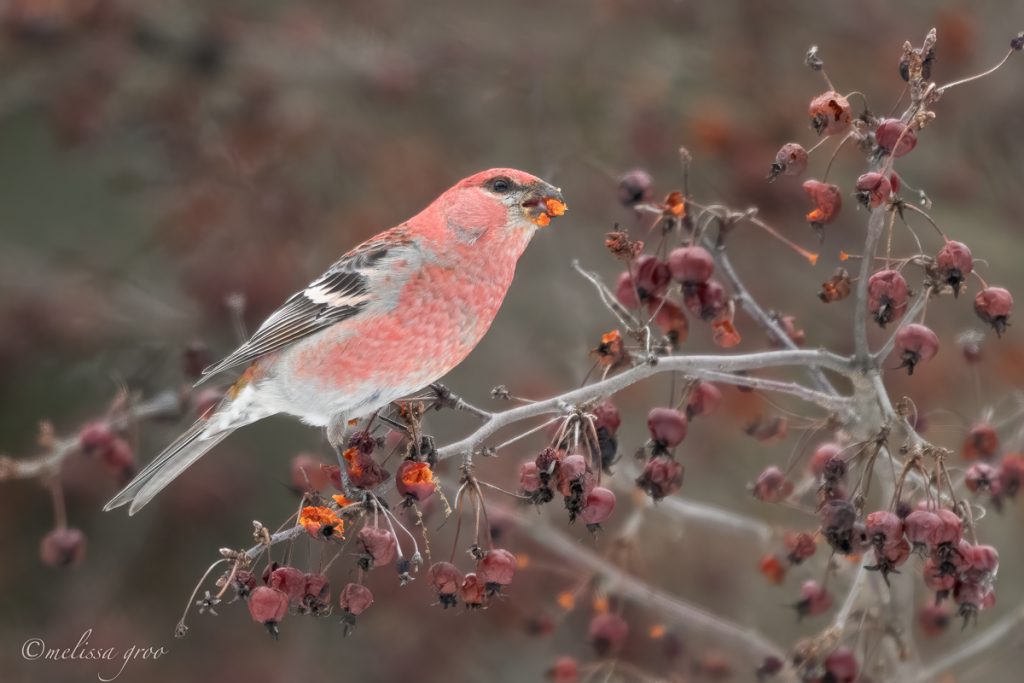
We do not expect much of a Pine Grosbeak flight after last year’s modest Great Lakes and northeastern United States irruption. There appears to be a pretty robust American mountain-ash fruit crop across much of the boreal regions that will hold birds to the north. Sure, there could very well be very small numbers in traditional areas of southeastern Canada and the border states, but don’t expect much of a flight this year.
Individuals wandering southward will look for European mountain-ash berries and small ornamental crabapples even in urban areas. At feeders, they prefer black oil sunflower seeds at large platform or hopper feeders.
PURPLE FINCH
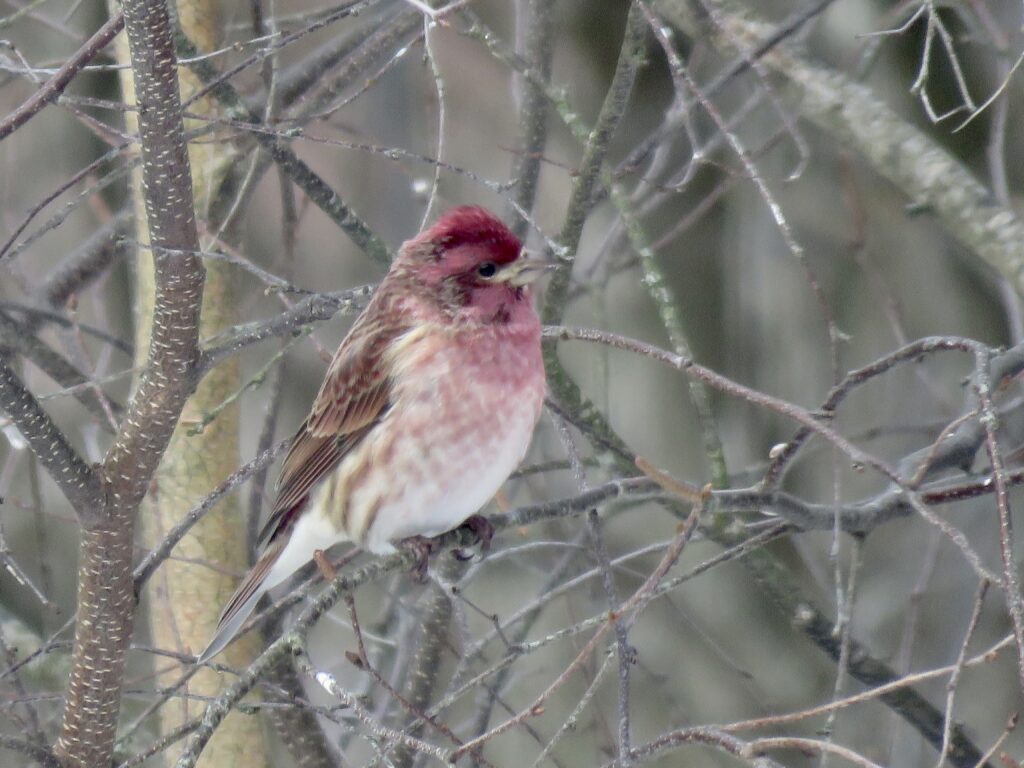
Given the spruce budworm outbreaks to the north across eastern Canada, and perceived uptick in population numbers of this species since the outbreaks began 10 years ago, are we now in a period where annual flights will be more common again? Maybe! There were back-to-back flights of Purple Finches in the east the last two years; 2024-25 was a moderate flight, and last year 2025-26 was a small to moderate flight.
Many Purple Finches will move into the areas of eastern Canada, the Great Lakes, and the northeastern United States this winter to take advantage of the good spruce and great eastern white pine and mountain-ash crops. Whenever these areas have good food crops, birds stay more to the north. Will we see another flight year to the Mid-Atlantic and southern states? If one does materialize, we suspect it will be a late-developing small flight at best due to abundant resources in the northeastern forests.
At feeders, Purple Finches prefer black oil sunflower seeds. Away from feeders, this species is known to feed on lilac, various ashes including mountain-ash (not a true ash, but a member of the rose family Rosaceae), and other deciduous and coniferous seeds during the winter.
REDPOLL
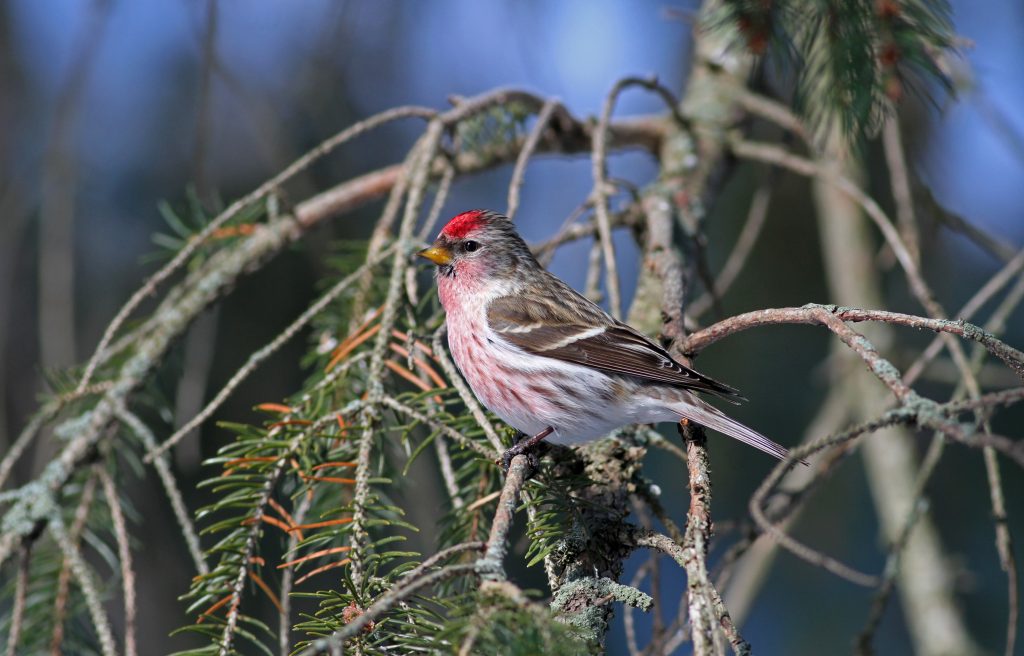
Birch seed crops on yellow, paper, gray and bog (swamp) birch all appear mixed and variable, but parts of Quebec and the Maritimes seem quite good. This will likely be a sufficient cushion to hold most Redpolls to the north in Canada. Maybe the western Great Lakes and perhaps northeastern border areas will get a small to modest irruption, but to be honest, this species has become increasingly harder to predict in the last 15-20 years. Given the August reports in the northeastern United States last year, we forecasted at least a moderate invasion year in southeastern Canada, the Great Lakes region, and northeastern United States, but it never really materialized. Sure, southeastern Canada and parts of the western Great Lakes had a small event, but larger numbers were absent and birds barely reached the United States. What likely potentially happened, is that many birds moved back across the boreal westward to areas where the crops were better, a pattern known from Pine Siskin and White-winged Crossbill. This transition seems a plausible explanation for last year’s movements given the push out of the St. Lawrence in August-September and that birds vanished or numbers really never built up as expected.
One other theory we have is that with global warming and the lack of snow cover, many Redpolls just stop before moving as far south as they used to, choosing to dine on increasingly accessible weed seeds in the snowless fields of Canada.
We do not expect a big flight this year, but a small flight wouldn’t surprise us either, especially in the western Great Lakes region. If any sizable flight does happen to materialize, a few “Hoaries” should be expected in larger flocks.
Watch for Redpolls on birches (including in urban areas), in weedy fields and at bird feeders offering Nyjer® and black oil sunflower seeds.
In 2024, Common Redpoll, Hoary Redpoll and the Lesser Redpoll in Europe were lumped into the same species, now called Redpoll. Genetic work found that a supergene was responsible for the Redpoll plumage differences. See the link below for photos and identification marks of the Redpoll subspecies.
RED CROSSBILL

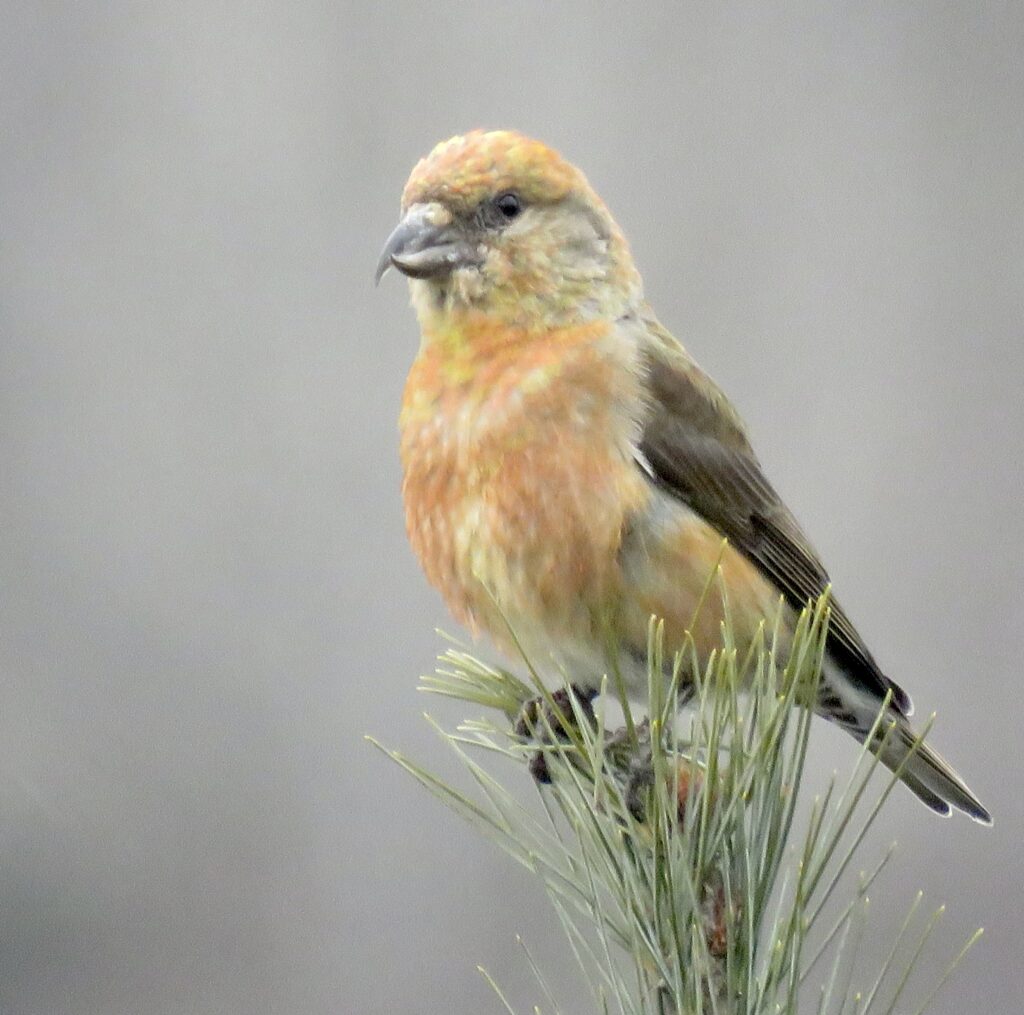
As noted above, there is a good to great eastern white pine crop, and a pretty good spruce crop in interior sections of southeastern Canada, the Great Lakes, and northeastern United States. Type 12 Red Crossbills will likely dominate in their usual conifer haunts across the northeastern United States and southeastern Canada, but there has also been a significant irruption of Type 2 Red Crossbills that has moved west to east across the country –this is again due to the poor pine crops in the interior west. Hawk Ridge and Whitefish Point have both reported larger than normal numbers since August and a big thanks goes out to them to reaching out and letting us know.
Type 2 waged a huge irruption west to east in 2023-24, the last time the northeastern United States had a great eastern white pine crop. A few have lingered as usual across the northeast since that irruption. But, now here comes a new irruption of Type 2s, and with them, a few Type 4s have moved eastward as well. A few Type 1 Red Crossbills will be scattered about as well, especially in western Massachusetts, southern New York, and points southward in the mountains of West Virginia and North Carolina.
There should be more good numbers of Red Crossbills from Algonquin Provincial Park to the southern Maritimes and northeastern United States. To begin winter, expect Type 2 to dominate more in the western Great Lakes, and Type 12 will dominate in the northeastern United States. In Algonquin Provincial Park, I could see a more even mix of Types 2 and 12. As the winter progresses, expect more Type 2s to make their way into the northeastern United States. Will more Type 4 or Type 3 come as well? Time will tell!
If numbers build, there may be a movement late winter down the coast to Long Island, Cape May, Delaware, and points south (especially Type 12), as they sometimes do, as cone crops get depleted as we progress through the winter season.
The Red Crossbill types are usually impossible to identify without recordings of their flight calls. Recordings can be made with a smartphone and identified to type. Matt Young (info@finchnetwork.org) will identify types if you email him your recordings or upload them to an eBird checklist. Matt and fellow FiRN board member Tim Spahr have now listened to upwards 30,000 recordings. Recordings uploaded to eBird checklists are deposited in the Macaulay Library. See the link at the bottom for more on the Red Crossbill call types.
WHITE-WINGED CROSSBILL
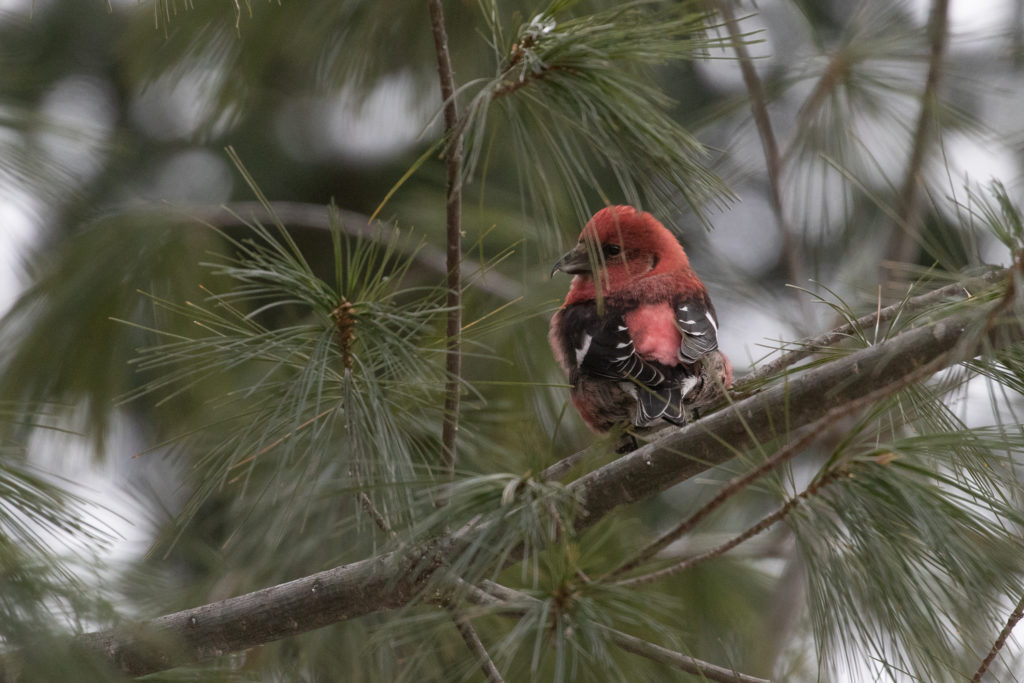
The crossbill pendulum has swung a bit back east some this year after most White-winged Crossbills were in the western boreal for the winter of 2025-26. An excellent spruce crop seems to be in a narrower area this winter located in Alaska to parts of British Columbia, and again in the east, but there is much less going on across the middle part of the boreal.
An influx of White-wings occurred in southeastern Canada, the northeastern United States, and the Great Lakes region in July, and some stayed and appeared to nest in the areas of good spruce crops. It was reported that many in the Sax Zim Bog area moved on/through however. So expect White-winged Crossbills to be in the far west and the far east. Outside of these two spruce crops, expect scattered flocks and individuals randomly moving around the Great Lakes region in search of suitable food sources, including any cone-laden spruces (including ornamentals) within urban areas.
Most crossbills remaining in the east should gravitate towards the interior areas of Ontario, Quebec, and the northeastern United States.
PINE SISKIN
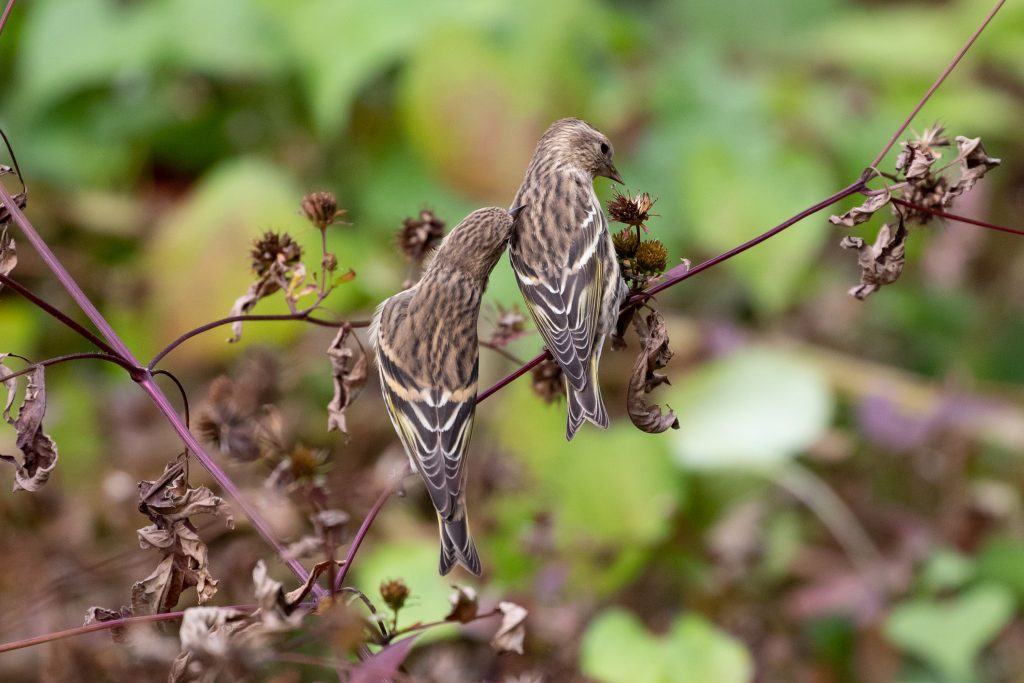
Like for Evening Grosbeak and Purple Finch, areas affected by spruce budworm infestations can provide bountiful food for the Pine Siskin. Pine Siskins were around in small numbers in the east this summer, but in recent weeks Tadoussac in Quebec has had numbers in the 100s several days. And at the edge western edge of this report in Hawk Ridge, Minnesota, they have had several days now over 1000 Pine Siskins.
Southeastern Canada, the Great Lakes region, and the northeastern United States have a very good northern white cedar crop (some areas have a good eastern hemlock crop as well), and siskins love cedar and hemlock seeds. The eastern white pine crop is also very good (spruce is good but more variable comparatively speaking), and the last time the eastern areas experienced a great eastern white pine crop in 2023-24 Pine Siskins were plentiful from January into spring. Again, this will be a year where several finches like Pine Siskins, the two crossbill species, and even Purple Finches will be found in the forests more than at feeders. So to find them one will have to venture out into the forested areas where the food is to find them.
As seen by band recoveries, Pine Siskins, similar to White-winged Crossbills, will move east or west in search of cone crops. This year, birds will move towards the good crops in the northeast and in British Columbia. The good crops will hold a lot of birds Northeastern states, but there could be a small flight to the southeastern states as well.
This entertaining species prefers Nyjer® seeds in silo or sock feeders, but also likes to dine on black oil sunflower seeds in tube feeders.
EVENING GROSBEAK
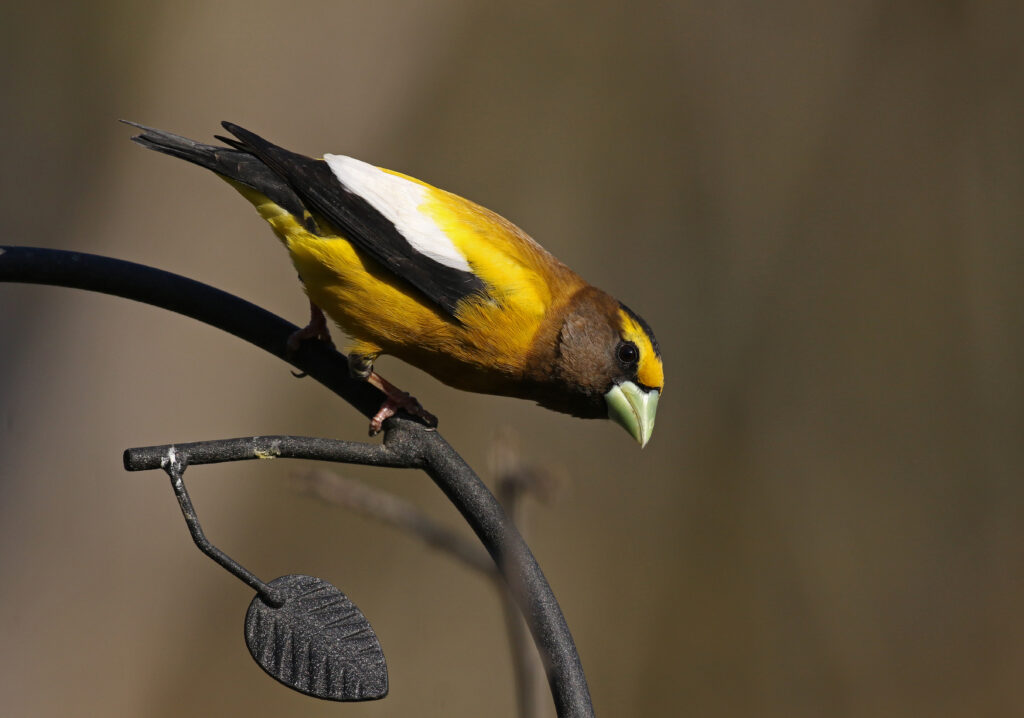
The budworm outbreak in the eastern boreal has now persisted in many areas for a decade or more, and for this budworm-loving finch, that has meant a local increase. Parents have been quite successful raising families on this abundant food source. Food sources used post-budworm, like cherry species, are not good this year, but the mountain-ash crop is, and we expect this will hold up some of the Evening Grosbeaks and Purple Finches (along with most of the Pine Grosbeaks). T
We predicted a moderate irruption in 2024-25, and a small one materialized. Last year we predicted a small irruption, and a moderately-sized one occurred. Either way, the northeastern United States has experienced at least small to moderate irruptions out of the boreal into southern New York and northwestern Pennsylvania the last two winters, and we’ve now had irruptions out of the boreal in 2020-21, 2022-23, 2024-25 and 2025-26, and that makes for irruptions 4 of the last 6 years. The Great Lakes has experienced a similar pattern the last 6 years, with 2022 being perhaps their largest event.
During the last big budworm outbreak from ~1965-1990, Evening Grosbeaks were noted on the Ithaca Christmas bird count, an area south of the boreal, every year from 1967-1991. Will we see another small movement south off the boreal this winter?
Small to medium-sized flocks will be found in the better grosbeak haunts in southeastern Canada near Algonquin PP (and villages and towns to the south), the Great Lakes region, and the northeastern United States this winter, so they will be findable. A small movement is quite possible again south of the boreal to southern New York, Pennsylvania and Massachusetts as well. It would not surprise us.
At platform feeders, Evening Grosbeaks prefer black oil sunflower seeds. Evening Grosbeaks will look away from feeders for maple and ash trees still holding seeds. See the links section below for the Evening Grosbeak call types eBird article, and The Evening Grosbeak Road to Recovery Project.
THREE IRRUPTIVE PASSERINES
Movements of these three passerines are often linked to the boreal finches.
BLUE JAY
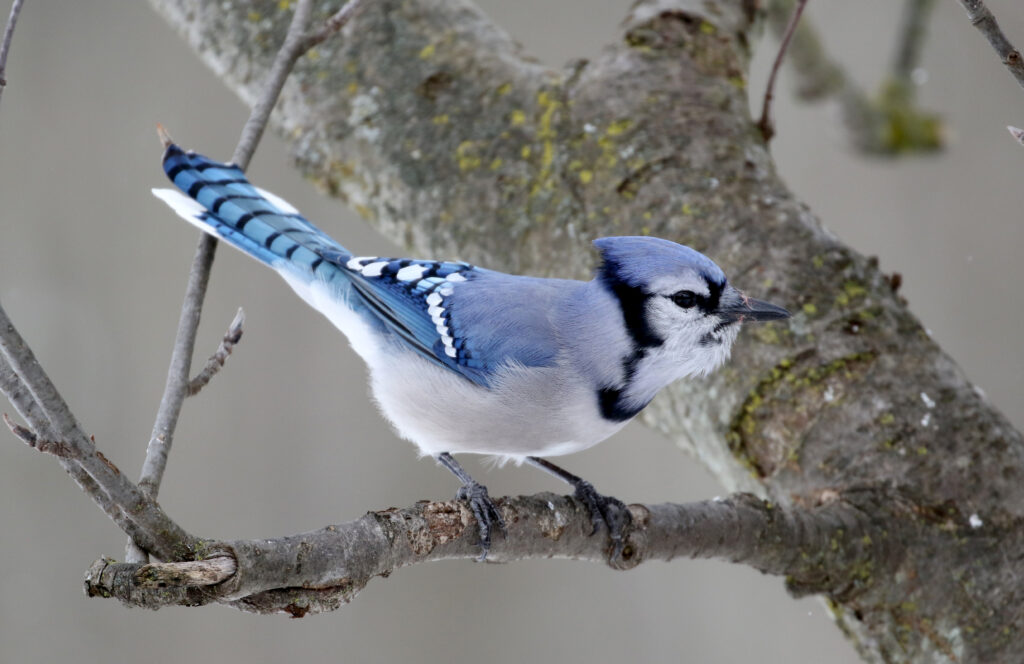
We suspect there will be an above average flight along the north shorelines of Lakes Ontario and Erie given the flight has been very large at the western edge of the forecast area in Hawk Ridge, Minnesota. The beechnut and acorn crop is quite good and widespread in the east, and birds should make it eastward. Hawk Ridge experienced several days of 1000+ flights, with over 13,000(!!) Blue Jays on September 16th.
With the poorer crops west of Lake Superior, there should be an above-average flight of Blue Jays southward along the western edge of this forecast, and some of the birds will surely head eastward where acorn crops are quite bumper.
Blue Jays love to cache food from sunflower and peanut feeders and more.
RED-BREASTED NUTHATCH
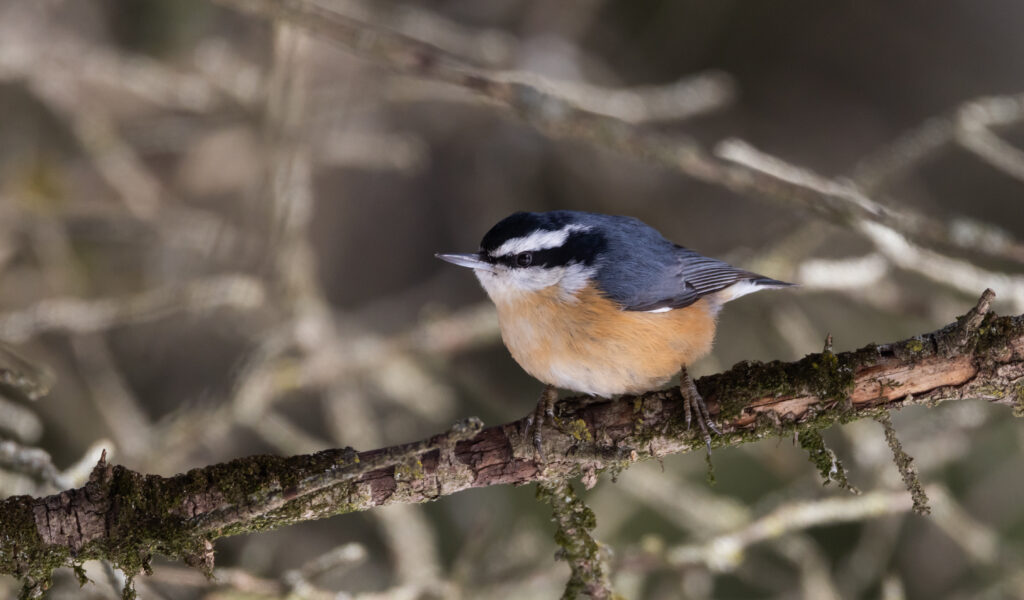
Last year this species irrupted in very large numbers in the east to the Gulf Coast States, but expect the good cone crops in the eastern areas to hold many birds to the north this year. We don’t expect a large eastern flight to the southeastern United States this year like last year.
At feeders, this species prefers black oil seeds, peanuts, and especially suet.
BOHEMIAN WAXWING
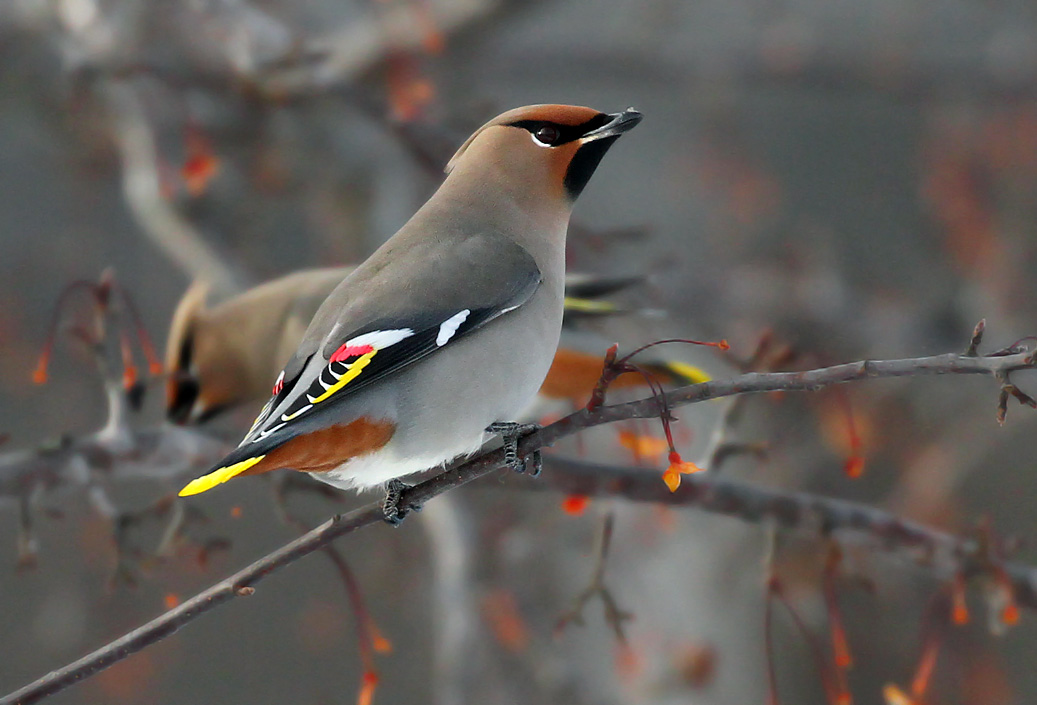
There appears to be a pretty fairly robust American mountain-ash fruit crop across large areas of the boreal forest that will hold birds to the north. Sure, there will be birds in traditional areas of southeastern Canada and the eastern border states, but don’t expect much of a flight south of those areas this year.
Cover Photo by Jamie Sylvan
The Finch Research Network (FiRN) is a nonprofit, and was granted 501c3 status in 2020. We are a co-lead on the International Evening Grosbeak Road to Recovery Project, and have funded over $30,000 to go towards research, conservation and education for finch projects in the last couple years. FiRN is committed to researching and protecting these birds like the Evening Grosbeak, Purple Finch, Crossbills, Rosy-finches, and Hawaii’s finches the honeycreepers.
If you have been enjoying all the finch forecasts, blogs and identifying of Evening Grosbeak and Red Crossbill call types (30,000+ recordings listened to and identified), Redpoll subspecies and green morph Pine Siskins FiRN has helped with over the years, please consider supporting our efforts and making a small donation at the donate link below. The Evening Grosbeak Project is in need of continued funding to help keep it going.
Donate – FINCH RESEARCH NETWORK (finchnetwork.org)
Book Link
For help with Finch ID and much much more, here is a link to the exciting and newly released Stokes Guide to Finches of the United States and Canada: https://www.amazon.com/Stokes-Finches-United-States-Canada/dp/0316419931
Shirt Link
For a commemorative Winter Finch Forecast shirt where proceeds will go towards the study and conservation of finches and their habitats globally, see here: https://finchnetwork.org/shop
The Finch Research Network has feedercams co-sponsored by Aspen Song Wild Bird Food, who is a member of Wild Bird Feeding Institute. Feedercams can be watched here: https://www.youtube.com/@FinchResearchNetwork
Please think about becoming a finch forecaster and joining Finch Research Network iNaturalist Projects (see links below for more projects):
Winter Finch Food Assessment Project/Become a Finch Forecaster: https://finchnetwork.org/the-finch-food-assessment-become-a-finch-forecaster
Finch Information Links
- Finch Research Network with finch species information https://finchnetwork.org/
- Crossbills of North America: Species and Red Crossbill Call Types: https://finchnetwork.org/crossbills-of-north-america-species-and-red-crossbill-call-types
- Type 12 Red Crossbill: https://finchnetwork.org/type-12-the-old-northeastern-red-crossbill
- A Crossbill’s Guide to Conifers of the Eastern Forest: https://finchnetwork.org/a-crossbills-guide-to-conifers-of-the-northeastern-forest
- A Crossbill’s Guide to Conifers of the Western Forest: https://finchnetwork.org/a-crossbills-guide-to-conifers-in-western-north-america
- Red Crossbill North American iNat Foraging Project: https://finchnetwork.org/crossbill-foraging-project
- Evening Grosbeak Call Types of North America: https://ebird.org/news/evening-grosbeak-call-types-of-north-americaTo support research and conservation for this species of conservation concern: https://finchnetwork.org/donate
- Quantitative analysis of the flight calls and trills of Evening Grosbeaks (Coccothraustes vespertinus): https://www.frontiersin.org/journals/bird-science/articles/10.3389/fbirs.2025.1613273/full
- Evening Grosbeak Road to Recovery Project: https://finchnetwork.org/projects/the-evening-grosbeak-project
- Evening Grosbeak North American iNat Foraging Project: https://finchnetwork.org/evening-grosbeak-foraging-project
- Evening Grosbeak iNat Window Collisions Project: https://www.inaturalist.org/projects/evening-grosbeak-window-collisions
- Flight calls of Eastern and Western Purple Finches (Haemorhous purpureus) are diagnostically different: https://www.frontiersin.org/journals/bird-science/articles/10.3389/fbirs.2026.1770303/full
- Subspecies of Common and Hoary Redpolls – ID Tips and Photos.http://www.jeaniron.ca/2015/redpollsRP.htm
- Redpolls are Lumped: Redpolls United! Highlights from the 2024 AOS Checklist Update | All About Birds
- Previous Winter Finch Forecasts 1999-2019: http://www.jeaniron.ca/WFFindex.htm
- 2020-2026 Winter Forecasts are available under the menu at https://finchnetwork.org/
I would like to thank the many birders, naturalists, biologists, and foresters who share their recordings and tree seed reports to contribute to this forecast:
The community of contributors has been large the last few years, so thanks to all listed here: Denis Barry (central and southern ON), Louise Barteau (ME), Juliet Berger (southeast MI), Jack Bowling (BC), Alvan Buckley (NFLD and southern Labrador), Peter Burke (central ON), Mark Calhoun (central and northwestern ON), Geoff Carpentier (southern ON and AK), Bernie Carr (northern NY), Caleb Centanni (NY, Northeast and MB to BC), Joan Collins (Adirondacks NY), Ian Cook, Clinton Dexter-Nienhaus (Sax-Zim Bog MN), Bruce Di Labio (ON, MB, PEI), Jessé Roy-Drainville (Gaspesie, and Tadoussac QC), Nancy Dowd (NS), Jolène Dubé (northern NB), David Elder (Atikokan ON), Michael Ferguson (northern ON), Harold Fisher (central SK), Matthew Forbes ( western MB) Marcel Gahbauer (eastern ON, AB), David Govatski (NH and VT), Glenn Hodgkins (ME), Danica Hogan (Yellowknife NWT), Peter Hogenbirk (Ontario), Adam Holder (northern ON), Joel Kayer (MB), Kent Ladell (southwestern AB), Susan Kielb (MI), Anne Marie Leger (northern NB), Markus Legzdins (northern ON), Mike Lushington (northern NB), Angela MacDonald (NS), Stacy McNulty (Adirondack NY), Mark Peck (Haliburton, Hudson Bay lowlands ON and eastern BC), Anne-Claude Pepin (Cape Breton NS), Tim Poole (MB), Brian Ratcliff (Lake Superior and northern ON), Colleen Reilly (Churchill MB), Bill Sheehan (northern ME), Sachi Snively (central BC), Tim Spahr (MA, BC), Donal Sutherland, Alexandre Terrigeol (Gaspesie and Tadoussac QC), Larry Therrien (western MA), Doug Tozer (northern ON), Declan Troy (AK), Greg Ward (Berkshire County MA), Mary Beth Warburton (NY), Magill Weber (southern ME, southeastern NB), Ken White (northwestern BC), Quinten Wiegersma (Algonquin Park ON), Angie Williams (NE Ontario), and Matt Young (NY, MA).
Thanks to Jay McGowan, Jessé Roy-Drainville, Tom Johnson, Ryan Brady, Melissa Groo, Ryan Mandelbaum, Jamie Sylvan, and Matt Young for providing the photos. Thanks to Tim Spahr, Caleb Centanni, Ken McEnamay, Lisa Crupe, and Matt Young for reviewing the forecast.
28th Annual Winter Finch Forecast: The first was posted to the Ontbirds and Birdchat listservs in 1999.
Tyler Hoar, Oshawa, Ontario. Finch Research Network, September 27, 2026.