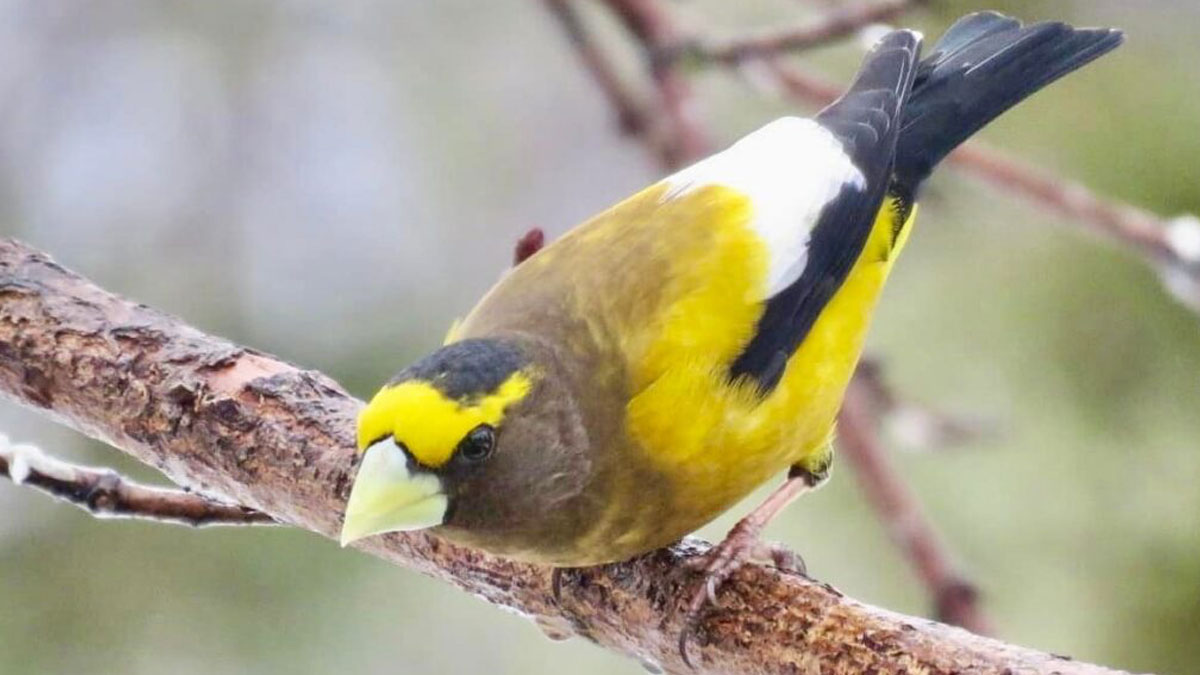
The Evening Grosbeak Working Group is looking for your help. As grosbeaks continue to move into our region in larger numbers this fall and winter there are three ways you can help our conservation efforts.
For decades this brightly colored finch was a beloved winter backyard feeder bird during its irruptions from northern or montane breeding areas. Recent studies show that Evening Grosbeak has lost more than 90% of its North American population since 1970. Collaborators from the Pennsylvania Natural Heritage Program at the Western Pennsylvania Conservancy, Finch Research Network, and the Carnegie Museum of Natural History’s Powdermill Avian Research Center formed an international working group with members from across North America focused on the species’ conservation as part of the Road to Recovery bird conservation initiative.
Help out this “grosbeak season”
- Report Banded Evening Grosbeaks
Partners from the Evening Grosbeak Working Group have color-banded hundreds of grosbeaks from non-breeding populations in the U.S. including, the Northeast. (Maine, New Hampshire, New York, Pennsylvania, Vermont), Midwest (Minnesota, Michigan), Interior West (Utah), Pacific Northwest (Oregon), as well as Quebec, Canada. Transmitters deployed on over 250 birds are showing migration routes to breeding areas in Manitoba, Newfoundland, Nova Scotia, Ontario, and Quebec for eastern birds and British Columbia, Idaho, Quebec and Wyoming for Midwest and western birds. Also, our reach is expanding as we add new banding efforts across the Evening Grosbeak range to collect more information to better understand this mysterious and declining bird.
Birders and backyard bird watchers can help with this effort by reporting observations of color-banded or tagged Evening Grosbeaks at your feeders! Each observation of one of these birds will add valuable information to help connect the dots as to why this bird has declined so much.
Please report banded or tagged Evening Grosbeaks to the USGS Bird Banding Lab at www.reportband.gov and email David Yeany at dyeany@paconserve.org.
Please note and record:
1. Location (Latitude/Longitude coordinates or address) and date
2. Sex of bird – male or female (all birds have adult looking plumage after Oct)
3. Band color combination – Example: RIGHT LEG: WHITE over METAL, LEFT LEG: BLACK over GREEN.
Upper and lower bands on each of the bird’s right and left legs. All banded birds will have a metal band plus up to 3 colored bands. Even partial combinations can be useful, and photos are even better!
Does the bird have a transmitter? If so, please note that too.
- Evening Grosbeak Window Collisions
Well over one billion birds die each year from collisions with windows in the United States alone. During the non-breeding months Evening Grosbeaks can spend large amounts of time near buildings with feeding stations – and glass windows. To better understand the Evening Grosbeak’s window collision vulnerability and the impact this threat has on populations, the Evening Grosbeak Working Group is seeking observations of Evening Grosbeak window collisions.
If you find an Evening Grosbeak that struck a window, please submit your observation to our simple iNaturalist project:https://www.inaturalist.org/projects/evening-grosbeak-window-collisions
- Evening Grosbeak Foraging
Food availability drives finch irruptions and we can better understand these mechanisms across the landscape with more observations that document what Evening Grosbeaks are eating – beyond just the typical sunflower seeds at feeders. If you see grosbeaks foraging on berries, tree seeds or any other food items, please add your observations to the Evening Grosbeak Foraging project on iNaturalist: https://www.inaturalist.org/projects/evening-grosbeak-foraging
Links:
Main Road to Recovery page:
Northern Woodlands Magazine article:
https://northernwoodlands.org/articles/article/save-fastest-declining-landbird
Cornell’s Living Bird magazine article:
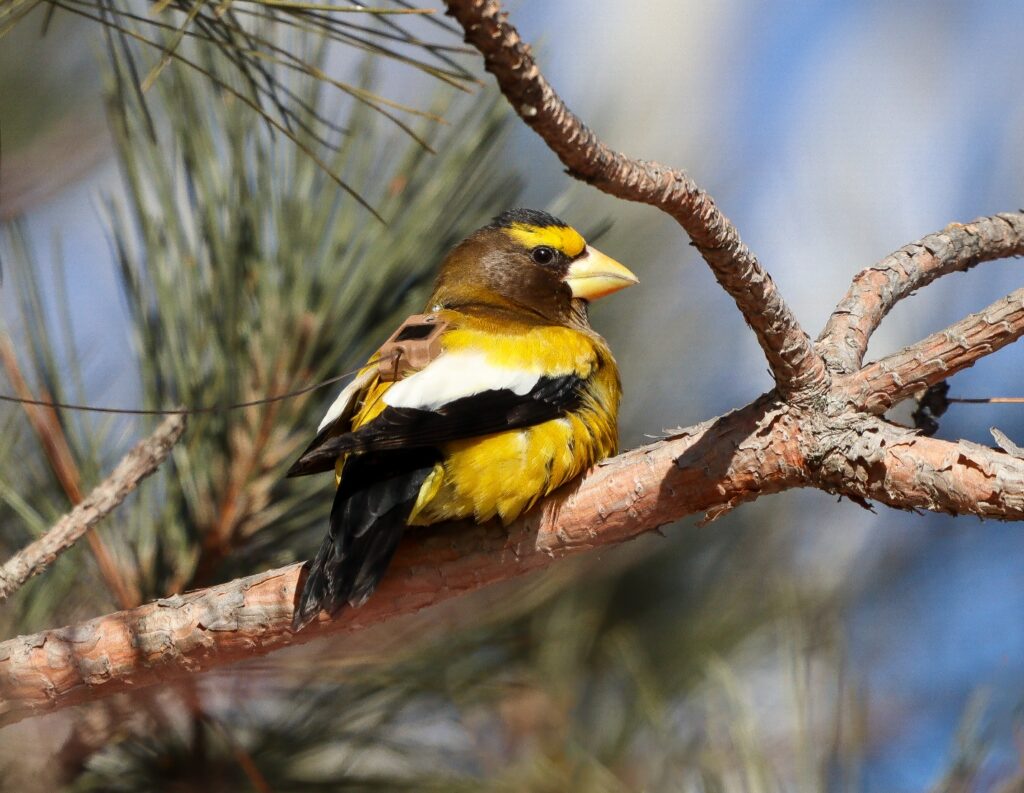
Photo: David Yeany II, PNHP-WPC
Don’t Let the Sun Set on Evening Grosbeaks
Take Action Against Collisions at Your Home!
https://www.fws.gov/story/dont-let-sun-set-evening-grosbeaks
Please think about joining Finch Research Network iNaturalist Projects:
Winter Finch Food Assessment Project/Become a Finch Forecaster (includes Evening Grosbeak): https://finchnetwork.org/the-finch-food-assessment-become-a-finch-forecaster
Red Crossbill Foraging Project: https://www.inaturalist.org/projects/red-crossbill-foraging-in-north-america
Book Link
For more on Evening Grosbeak’s and much much more, here is a link to the exciting and newly released Stokes Guide to Finches of the United States and Canada: https://www.amazon.com/Stokes-Finches-United-States-Canada/dp/0316419931
Shirt Link
For a commemorative Winter Finch Forecast shirt or a newly released Goldfinch shirt with all 3 Goldfinch species that makes for a great holiday present, see here: https://finchnetwork.org/shop
The Finch Research Network (FiRN) is a nonprofit, and was granted 501c3 status in 2020. We are a co-lead on the International Evening Grosbeak Road to Recovery Project, and have funded almost $22,000 to go towards research, conservation and education for finch projects in the last couple years. FiRN is committed to researching and protecting these birds like the Evening Grosbeak, Purple Finch, Crossbills, Rosy-finches, and Hawaii’s finches the honeycreepers.
If you have been enjoying all the finch forecasts, blogs and identifying of Evening Grosbeak and Red Crossbill call types (20,000+ recordings listened to and identified), redpoll subspecies and green morph Pine Siskins FiRN has helped with over the years, please think about supporting our efforts and making a small donation at the donate link below. The Evening Grosbeak Project is in need of continued funding to help keep it going.